
Emerson Thermostat 1F80: A Comprehensive Guide
As winter approaches‚ maintaining a comfortable home temperature is crucial; the Emerson 1F80 thermostat offers centralized heating control for cozy living spaces.
The Emerson 1F80 non-programmable thermostat is a widely utilized model designed for simple and reliable temperature regulation within residential settings. It’s a popular choice for those seeking a straightforward heating and cooling control solution‚ without the complexities of advanced scheduling features. This thermostat is particularly favored for its ease of installation and user-friendly interface‚ making it accessible to a broad range of homeowners;
As colder months approach‚ ensuring a comfortable indoor climate becomes paramount. The 1F80 allows for manual adjustments to maintain desired temperatures‚ offering a practical solution for consistent warmth. Understanding its basic functions and capabilities is key to maximizing its benefits and ensuring efficient home comfort throughout the heating season and beyond.
What is the Emerson 1F80 and its Purpose?
The Emerson 1F80 is a basic‚ non-programmable thermostat primarily intended to control forced-air heating and cooling systems in homes. Its core purpose is to maintain a consistent indoor temperature by switching the HVAC system on or off based on the setpoint chosen by the user. Unlike programmable models‚ the 1F80 requires manual adjustments whenever a temperature change is desired;
This thermostat serves as a central control point for home comfort‚ allowing occupants to easily regulate warmth during winter and coolness during summer. It’s designed for simplicity‚ making it ideal for individuals who prefer a straightforward approach to temperature management‚ without the need for complex scheduling or smart home integration. It’s a reliable solution for consistent climate control.
Key Features of the 1F80 Model
The Emerson 1F80 distinguishes itself through its user-friendly design and straightforward functionality. Key features include simple up/down temperature adjustment buttons‚ offering precise control over heating and cooling. A clear‚ easy-to-read display shows the current room temperature and the setpoint. It operates on batteries‚ ensuring continued function even during power outages.
The thermostat supports both heating and cooling modes‚ selectable via a dedicated switch. Its non-programmable nature simplifies operation‚ eliminating the need for complex scheduling. The 1F80 is built for durability and reliability‚ providing consistent performance. While lacking advanced features like Wi-Fi connectivity‚ it excels in providing basic‚ dependable temperature regulation for residential spaces.

Installation and Setup
Proper installation ensures optimal performance; carefully follow the wiring diagram and battery installation instructions for a seamless setup of your Emerson 1F80 thermostat.
Initial Installation Steps
Before beginning‚ ensure your HVAC system is powered off at the breaker to prevent electrical shock. Carefully remove your old thermostat‚ noting the wire connections – a photograph is highly recommended! Label each wire clearly corresponding to its terminal on the old unit.
Using the provided mounting plate‚ secure it to the wall at the desired location‚ ensuring it’s level. Connect the wires to the corresponding terminals on the Emerson 1F80’s baseplate‚ referencing the wiring diagram (detailed in a separate section).
Gently push any excess wire back into the wall. Attach the thermostat body to the baseplate‚ ensuring a secure fit. Finally‚ restore power to your HVAC system at the breaker. The thermostat should power on‚ initiating the setup process.
Wiring Diagram for the 1F80
Understanding the wiring is critical for proper operation. Typically‚ the R terminal connects to 24VAC power‚ while C is the common wire – essential for consistent power. W controls heating‚ Y controls cooling‚ and G activates the fan.
For systems with auxiliary heat‚ a W2 terminal may exist. If you have a reversing valve‚ connect it to the O/B terminal (configuration depends on your HVAC system type).
Important: Incorrect wiring can damage your HVAC system or thermostat. If unsure‚ consult a qualified HVAC technician. A common configuration involves Rh and Rc jumpers if you only have one transformer wire. Always double-check connections against your system’s specific wiring and the diagram included with your Emerson 1F80.
Battery Installation and Replacement
The Emerson 1F80 typically requires two AA alkaline batteries for operation‚ even when connected to 24VAC power. Batteries serve as a backup‚ maintaining settings during power outages and powering the display.
To install‚ locate the battery compartment (usually on the front or side of the thermostat) and open it. Insert the batteries‚ ensuring correct polarity (+ and -). A low battery indicator will appear on the display when replacement is needed.
Always replace both batteries simultaneously with fresh ones to prevent potential issues. Using rechargeable batteries is generally not recommended. Battery life varies depending on usage‚ but expect to replace them annually.
Operating the Emerson 1F80
Effectively managing your home’s climate relies on understanding the 1F80’s controls‚ including display icons‚ temperature settings‚ and programmable schedules for optimal comfort.
Understanding the Display Icons
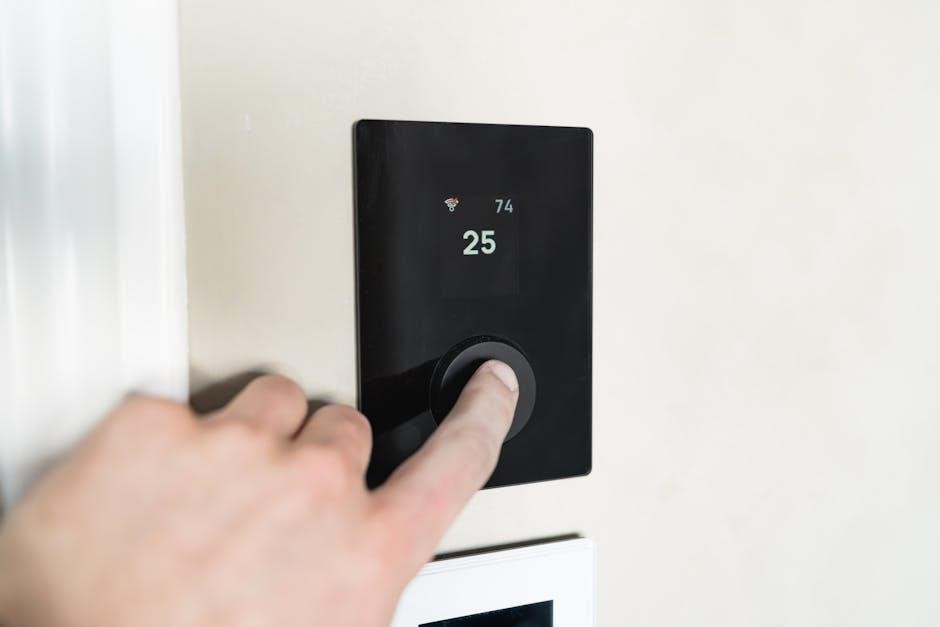
The Emerson 1F80 thermostat utilizes a series of icons to communicate its current status and operational mode. Familiarizing yourself with these symbols is essential for effective control of your home’s heating and cooling system. A flame icon typically indicates the heating system is actively running‚ providing warmth. Conversely‚ a snowflake icon signifies that the cooling system is engaged‚ delivering cool air.
A fan icon displays the fan’s operational status – ‘Auto’ means the fan runs only during heating or cooling cycles‚ while ‘On’ indicates continuous fan operation. Battery indicators alert you to low battery levels‚ prompting replacement. Other icons may represent system errors or specific settings‚ such as program mode or filter change reminders. Consulting the full Emerson 1F80 manual provides a detailed explanation of each icon‚ ensuring you can quickly interpret the thermostat’s feedback and adjust settings accordingly for optimal comfort and efficiency.
Setting the Temperature – Heat and Cool Modes
Adjusting the temperature on your Emerson 1F80 is straightforward‚ allowing you to easily switch between heating and cooling modes. To raise the temperature in Heat mode‚ press the ‘Up’ button; to lower it‚ press ‘Down’. The current setpoint is prominently displayed on the screen. Similarly‚ in Cool mode‚ the ‘Up’ and ‘Down’ buttons control the desired cooling temperature.
Ensure the thermostat is correctly set to ‘Heat’ or ‘Cool’ using the ‘Mode’ button before making temperature adjustments. The selected mode will be indicated by a corresponding icon on the display. For optimal comfort‚ start with small adjustments and allow the system time to respond. Remember that significant temperature changes may take longer to achieve‚ depending on your home’s insulation and the external weather conditions. Refer to the complete manual for detailed instructions and troubleshooting tips.
Programming Schedules for Energy Savings
The Emerson 1F80 allows you to create customized heating and cooling schedules‚ maximizing energy efficiency and reducing utility bills. Programming involves setting different temperatures for various times of the day and days of the week. For example‚ you can lower the temperature while you’re away at work or asleep‚ and raise it before you return home or wake up.
Access the programming mode through the thermostat’s menu‚ typically using the ‘Menu’ or ‘Prog’ button. Follow the on-screen prompts to set the desired temperature for each period. Consider creating separate schedules for weekdays and weekends to accommodate different routines. Regularly review and adjust your schedule to optimize energy savings based on your lifestyle and seasonal changes. Detailed instructions are available in the full Emerson 1F80 manual.

Troubleshooting Common Issues
Addressing problems promptly ensures consistent comfort. Common concerns with the Emerson 1F80 include power failures‚ inaccurate readings‚ and occasional connectivity disruptions.
Thermostat Not Turning On
If your Emerson 1F80 thermostat fails to power on‚ several factors could be at play. First‚ meticulously check the battery installation‚ ensuring correct polarity and fresh batteries. A loose connection or depleted power source is a frequent culprit.
Next‚ verify the circuit breaker controlling your HVAC system hasn’t tripped. A reset might be all that’s needed. Inspect the wiring connections at both the thermostat and the furnace/air handler‚ looking for any loose or disconnected wires.
Confirm the thermostat is set to a mode requiring power (Heat‚ Cool‚ or Auto)‚ not simply ‘Off’; If issues persist‚ consult a qualified HVAC technician to diagnose potential problems with the HVAC system itself or the thermostat’s internal components.
Incorrect Temperature Readings
Experiencing inaccurate temperature readings on your Emerson 1F80 thermostat can lead to discomfort and energy waste. Begin by ensuring the thermostat isn’t directly exposed to sunlight‚ drafts‚ or heat-generating appliances‚ as these can skew readings.
The 1F80 offers a temperature calibration feature; access this through the settings menu to adjust the displayed temperature to match a trusted thermometer. Check for obstructions blocking airflow around the thermostat‚ hindering accurate sensing.
If the problem continues‚ consider a reset to factory defaults (refer to the maintenance section) as a troubleshooting step. Persistent inaccuracies may indicate a failing temperature sensor‚ requiring professional HVAC assistance for diagnosis and potential replacement.
Connectivity Problems (if applicable ― some 1F80 models have limited connectivity)
Certain Emerson 1F80 models offer limited connectivity features‚ and experiencing issues with these can be frustrating. If your model supports Wi-Fi or app control‚ first verify your home network is functioning correctly and the thermostat is within range of the router.
Ensure the correct Wi-Fi password was entered during setup. Try restarting both the thermostat and your router to refresh the connection. Check the Emerson website or app for firmware updates‚ as these often address connectivity bugs.
If problems persist‚ consult the Emerson support documentation or contact their customer service for assistance‚ as advanced troubleshooting may be required.

Advanced Features & Settings
Explore enhanced control options like customized fan settings and convenient filter change reminders‚ optimizing your Emerson 1F80 for peak performance and efficiency.
Fan Control Options (Auto‚ On)
The Emerson 1F80 thermostat provides two primary fan control settings: Auto and On. Understanding these options is key to optimizing both comfort and energy efficiency within your home.
In “Auto” mode‚ the fan operates only during heating or cooling cycles. This means the fan will turn on when the system actively produces warm or cool air‚ and then shut off once the desired temperature is reached. This is generally the most energy-efficient setting‚ as it avoids unnecessary fan operation.
Selecting “On” mode forces the fan to run continuously‚ regardless of whether the heating or cooling system is actively engaged. This can provide more consistent air circulation throughout your home‚ potentially improving comfort‚ especially in larger spaces. However‚ continuous fan operation will consume more energy. Consider using this setting if you want to distribute air more evenly or improve air filtration.
To switch between these modes‚ refer to your thermostat’s display and button configuration‚ typically found within the system settings menu.
Filter Change Reminders
Maintaining a clean air filter is crucial for optimal HVAC system performance and indoor air quality. The Emerson 1F80 thermostat often includes a helpful filter change reminder feature to assist you in this important maintenance task.
This reminder isn’t automatic; you typically need to manually set it within the thermostat’s settings menu. The system allows you to program a reminder based on a specific time interval – for example‚ every 30‚ 60‚ or 90 days – or based on accumulated run time.

When the programmed interval is reached‚ the thermostat will display a visual alert‚ often an icon or message‚ reminding you to replace the air filter. Ignoring this reminder can lead to reduced airflow‚ increased energy consumption‚ and potential damage to your HVAC system. Regularly changing your filter ensures efficient operation and cleaner air for your home.
Temperature Calibration
Occasionally‚ thermostats may exhibit slight inaccuracies in temperature readings. The Emerson 1F80 allows for temperature calibration‚ enabling you to adjust the displayed temperature to match a trusted external thermometer.
Accessing the calibration feature typically involves navigating through the thermostat’s settings menu. You’ll usually find an option labeled “Calibration” or “Temperature Offset.” This allows you to increase or decrease the displayed temperature by a specified degree or two.
It’s recommended to compare the thermostat’s reading with a calibrated thermometer placed nearby. If there’s a discrepancy‚ adjust the calibration setting accordingly. Small adjustments can significantly improve the accuracy of your temperature control‚ ensuring greater comfort and potentially reducing energy waste by preventing unnecessary heating or cooling cycles.

Maintenance and Care
Regular cleaning and proper storage extend the lifespan of your Emerson 1F80. Resetting to factory defaults can resolve persistent operational issues effectively.
Cleaning the Thermostat
Maintaining a clean Emerson 1F80 thermostat ensures accurate readings and optimal performance. Before cleaning‚ always turn off power to the HVAC system at the breaker to prevent electrical shock. Gently remove the thermostat cover – consult your manual for specific instructions‚ as methods vary slightly.
Use a soft‚ dry cloth to wipe down the exterior of the thermostat and the cover. Avoid abrasive cleaners or solvents‚ as these can damage the plastic or display screen. For stubborn dirt‚ lightly dampen the cloth with water‚ ensuring it’s not dripping wet.
Do not spray any liquids directly onto the thermostat. Pay particular attention to cleaning around the display and buttons. Once clean and dry‚ carefully reattach the cover. Regular dusting can prevent buildup and maintain a tidy appearance‚ contributing to the longevity of your thermostat.
Long-Term Storage Guidelines
If you need to store your Emerson 1F80 thermostat for an extended period‚ proper preparation is essential to prevent damage and ensure functionality upon retrieval. First‚ remove the batteries to avoid corrosion and potential leakage‚ which can irreparably harm the device’s internal components.
Carefully detach the thermostat from the wall plate‚ noting the wiring configuration for easy reinstallation. Store the thermostat and its components in a clean‚ dry‚ and temperature-stable environment‚ away from direct sunlight‚ extreme temperatures‚ and humidity.
Consider using the original packaging or a protective container to shield it from physical damage. Avoid storing near magnetic fields or sources of dust. Properly stored‚ your Emerson 1F80 will be ready for use when needed‚ preserving its operational life.
Resetting the Thermostat to Factory Defaults
Occasionally‚ you may need to reset your Emerson 1F80 thermostat to its original factory settings. This is particularly useful when troubleshooting persistent issues or preparing the device for a new installation. The process typically involves a specific sequence of button presses‚ though the exact method can vary slightly.
Generally‚ you’ll need to access the settings menu‚ often by pressing and holding the ‘Menu’ or ‘Set’ button. Navigate through the options until you find a ‘Reset’ or ‘Factory Defaults’ option. Confirm your selection‚ and the thermostat will restart with its original programming.
Be aware that resetting will erase all custom schedules and settings‚ returning the thermostat to its out-of-the-box configuration. Consult the full Emerson 1F80 manual for precise instructions tailored to your specific model.

Compatibility and Alternatives
The Emerson 1F80 typically works with standard HVAC systems‚ but newer Emerson models offer smart features and improved connectivity for modern homes.

Compatible HVAC Systems
The Emerson 1F80 thermostat demonstrates broad compatibility with a wide range of conventional heating and cooling systems commonly found in residential properties. Specifically‚ it’s designed to function effectively with forced air furnaces – including gas‚ oil‚ and electric models – as well as central air conditioning units.
Furthermore‚ the 1F80 is generally suitable for heat pump systems‚ though careful wiring is essential to ensure proper operation. It supports both millivolt and 24-volt systems‚ expanding its applicability. However‚ it’s not typically compatible with line voltage baseboard heaters or systems requiring specialized communication protocols beyond its capabilities.
Always consult the detailed wiring diagrams within the Emerson 1F80 manual and‚ if uncertain‚ seek guidance from a qualified HVAC technician to confirm compatibility with your specific system before installation.
Comparing the 1F80 to Newer Emerson Models
The Emerson 1F80 represents an earlier generation of Emerson thermostats‚ differing significantly from their contemporary counterparts. Newer models‚ like the Sensi series‚ boast Wi-Fi connectivity‚ enabling remote control via smartphone apps and integration with smart home ecosystems – a feature absent in the 1F80.
Modern Emerson thermostats also offer enhanced energy reporting and learning capabilities‚ adapting to user preferences for optimized energy savings. While the 1F80 provides basic programmable scheduling‚ it lacks the advanced algorithms found in newer versions.
Display technology has also evolved; newer models feature larger‚ higher-resolution screens; However‚ the 1F80 remains a reliable‚ cost-effective option for basic temperature control‚ particularly for those without smart home aspirations.